Showing posts with label iPad. Show all posts

Sunday, July 3, 2011

the iPad, revisited with Brushes

One of the reasons that I was all keen on getting an iPad was to have the chance to use a program (oh, excuse me, an app) called Brushes, which I'd read about off and on in the past couple of years. In particular, I'd heard about artist David Hockney's work with the program, and while some of his drawings on the iPad seem a touch on the cheesy side to me, I was excited about the idea of having a fairly portable painting studio that I could leave and come back to without any cleanup to speak of.

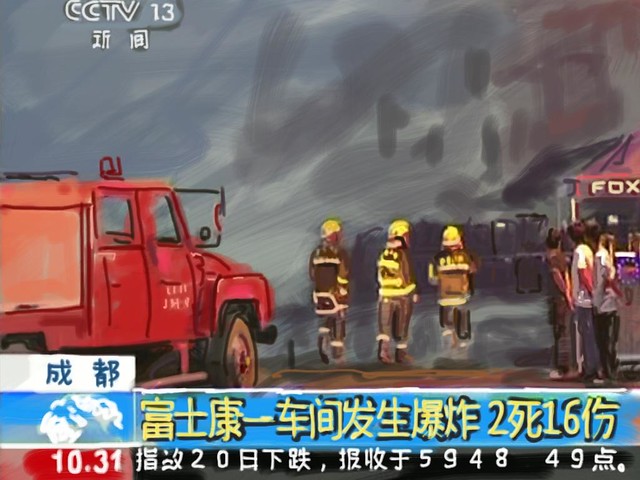
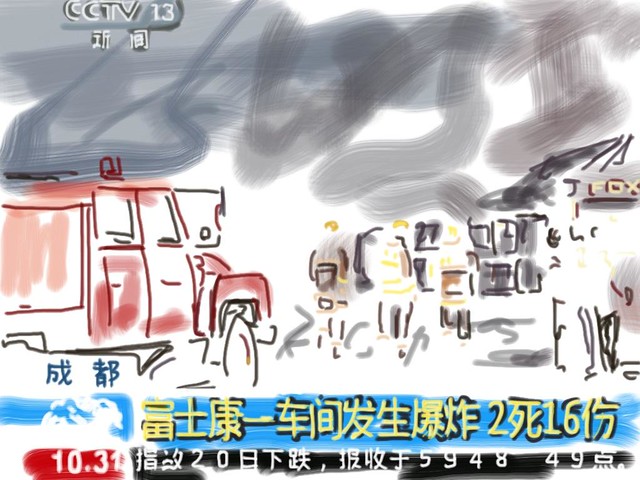
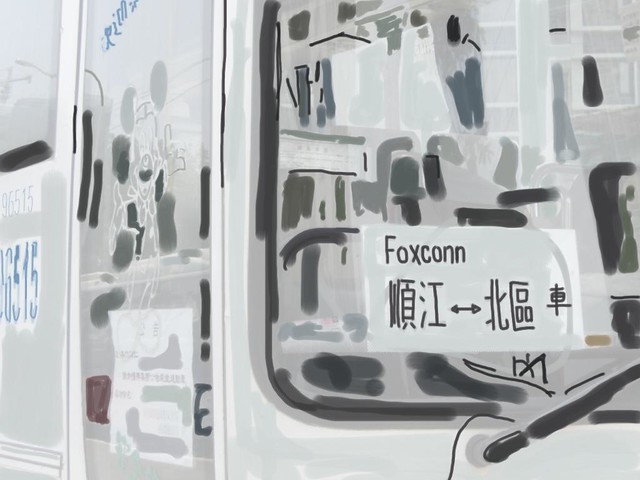
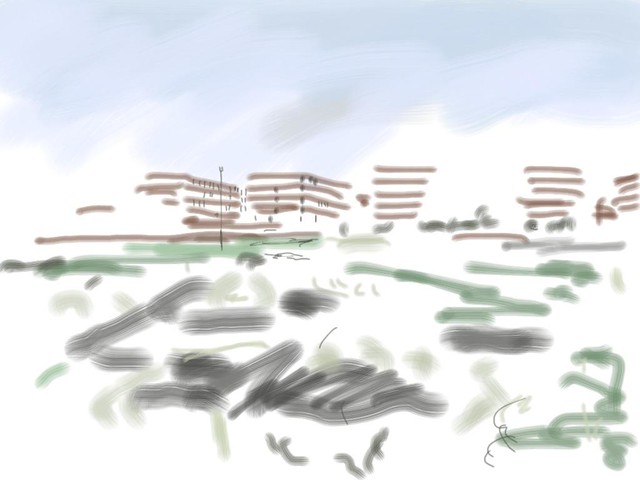
And then, right as we got the iPad, the news came in of the explosion in the nearby factory that produced it. The world news cycle has, of course, moved on, and we've had other things going on with our lives as well, but I'm still intrigued with the story. So while it might not be the prettiest subject for a set of paintings, I decided to make the explosion, and the events and landscapes surrounding it, the subject for my first experiments with the program. Here are some of my first attempts, presented without comment for now...

Foxconn Factory Explosion News Coverage, v1

Foxconn Factory Explosion News Coverage, v2

Bus for workers, Foxconn plant, Chengdu

Rice fields and worker dormitories, Chengdu Foxconn plant, v2

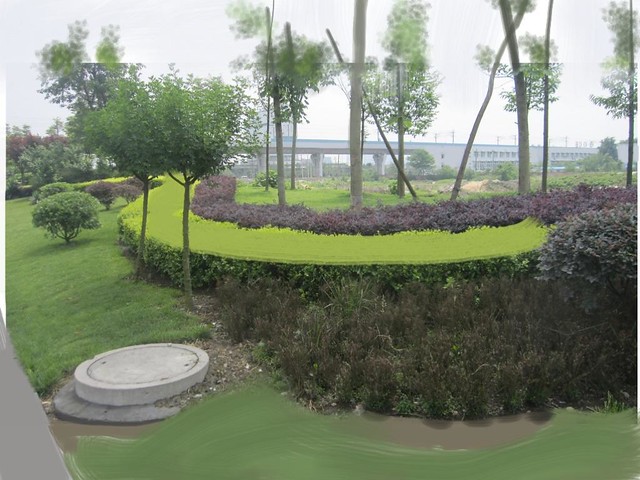
Landscaping and High Speed train tracks, Foxconn plant, Chengdu

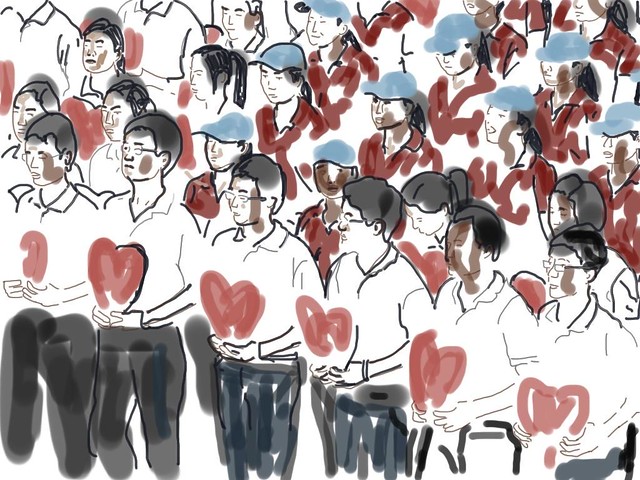
"Love Life" Suicide Prevention Rally, Foxconn Factory, Shenzhen

Wednesday, June 1, 2011

the iPad and us (part 4 - the outside scoop)

As the recent explosion at the local Foxconn factory slowly marches its way into the territory that is Yesterday's News, I thought I'd show some pictures I took while biking around the plant on the Sunday after the accident. There's been a lot of coverage of the conditions inside the factory, which I can't really add to, but not so much on what's outside. Herewith, then, some local context...

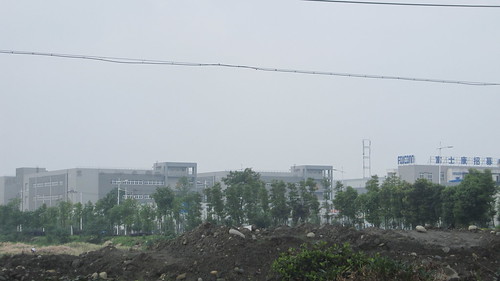
IMG_6400
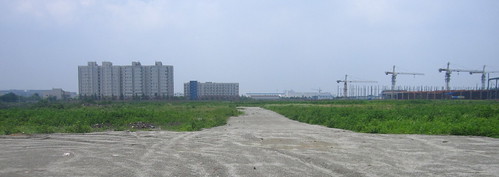
The Foxconn plant from afar. Note the piles of rubble from construction (or more accurately, destruction of a previous building) in the foreground - a prominent feature in the local landscape.

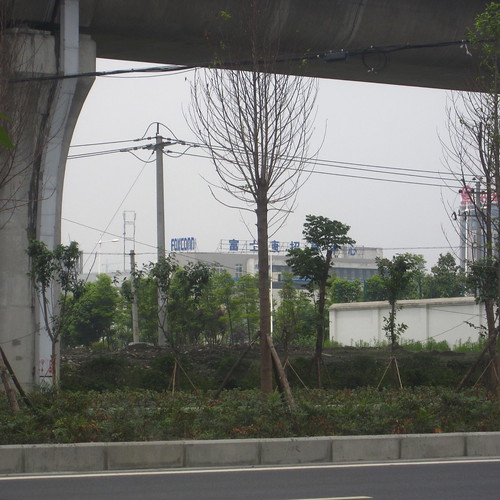
IMG_6391 IMG_6396
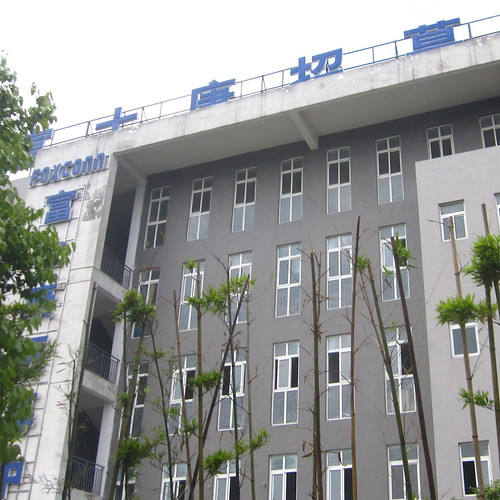
Another distant view of the plant with the new high speed train in the foreground, and the employee entrance close up. From the outside, I couldn't see any obvious damage to the plant.

IMG_6397 IMG_6398
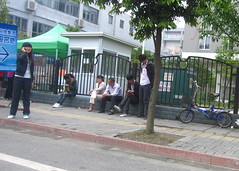
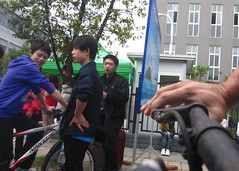
That Sunday, there were maybe 100-150 workers gathered around the factory entrance. I was getting some stares from security guards, so I just snapped a few pictures on the sly as I biked by, feeling a bit like a spy...

IMG_6395
A construction site that's presumably a new section of the Foxconn factory being built.

IMG_6403
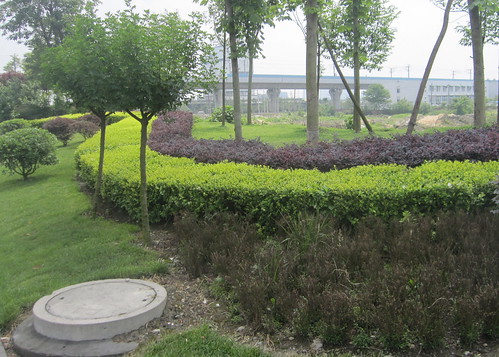
Landscaping surrounding the plant, with the new high speed train in the background. Note the ubiquitous double colored hedges, which are all trimmed by workers with orange safety vests and hand shears.

IMG_6401
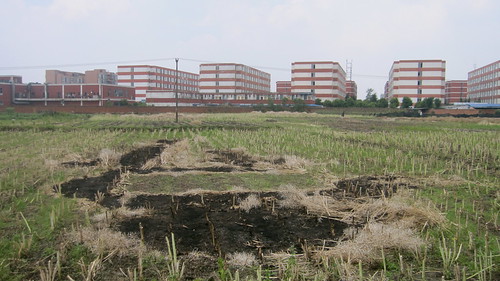
A rice field that's been recently burned off, with what I think are some of Foxconn's worker dorms in the background.

IMG_6399
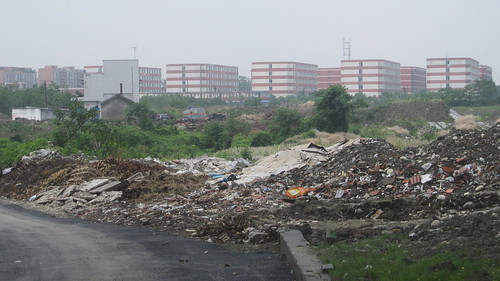
The dorms again with - you guessed it - another pile of rubble, this one also serving as a local garbage dump from the look of it.

If all this strikes you as fairly mundane and boring, it's because - well, it is. The whole area from here to Chengdu, which used to be mostly villages and rice fields as recently as five years ago, looks more or less like this now. I'm guessing that the only thing makes the Foxconn plant significantly different from the hundreds of factories and warehouses that now surround it is that it makes parts for a high-profile American company, and thus gets in the news when something bad happens.

Saturday, May 28, 2011

the iPad and us (part 3 - the Story of Stuff)

Okay, here's a little video interlude in this whole bit. Ironically, it was the video I had shown to my students on the Thursday before the iPad plant explosion on Friday.


Yeah, I know, it's a bit simplified and propagandistic (and hey, what isn't?), but her main points are fairly clear and succinct, and bear repeating:
  • Most electronic products are "designed for the dump", that is, they are made to become quickly obsolete, so that consumers will get rid of them and buy new products and a faster rate.
  • The amount of time that we own our electronic devices is just a short blip in their life cycle; they start affecting the environment from the moment their raw materials are extracted, and they continue to harm the environment through the release of toxins long after we throw them away.
  • There are many externalized costs in the manufacture of consumer goods - negative effects from these products on people and the environment that are not paid by either the consumer or the manufacturer.
  • Around the world, consumers are starting to demand that manufacturers start programs for product takeback - that they bear the burden of safely recycling their products after disposal.
And, just to bring home the point that it isn't just cartoons she's talking about, I showed the class a few pictures by Canadian photographer Edward Burtynsky, including the following, taken at recycling facilities in the Southeast of China.


Next up: Getting closer to home....

Friday, May 27, 2011

the iPad and us (part 2 - full disclosure)

Okay, here's the thing. Jane and I, lesson planners, web surfers, international corresponders, digital photographers, and all around online junkies that we are, have sometimes been known to (brace yourself here) fight over who gets to use our household's one computer - an Apple MacBook that will turn five years old (I think that's around 167 in dog years) this summer. Add three kids clamoring to watch a video or go onto Starfall.com every now and then, and we soon started thinking that we wanted to get another computer. No, we needed a new computer. Funny how these things escalate, isn't it?

And we wanted an Apple - not so much because we're fiercely partisan in the whole Mac vs. Windows war, but because we've had Macs for the last going on ten years now, and it would be a huge pain to switch over. And there's viruses, spyware, the hassle of buying any kind of computer in China with government-mandated software, the fact that our Macs have been incredibly reliable over their lifetimes, and the additional fact every time I've used a PC lately, I've felt like I'm driving a 1986 Buick Skylark. (So yeah, maybe we do lean to the Mac side here, don't we?)

It was about then that the news of the iPad 2 came out. It's an iPad! And hey, wow, there's a big number 2 after it! And all for less than half the price of a (new Apple) laptop! I had heard about David Hockney's iPad paintings before, so I was already hooked on the idea of getting one. All it took was a session of Fruit Ninja on a friend's iPad in Chengdu, and Jane was in as well.


And if it's good enough for David Hockney, it's good enough for me...

So, a couple of bits of research here, a couple of online ordering sections there, and our American credit card, and I'd ordered an iPad (black, 3g enabled, no-engraving-on-the-back-but-thanks anyway) to be shipped to our organizations headquarters in Virginia so that it would arrive in time for our boss to bring it to us when he was due out in mid May. Which he did, and now we are the proud owners of a new iPad, complete with the painting application, a pretty cool Chinese dictionary, and yes, Fruit Ninja...


(the real productivity tool that we've been looking for)

Now back up a moment - did anyone notice anything strange here? Remember what the Foxconn factory down the road makes? Yep, the iPad2. So there's a pretty good chance that our iPad could have been made in Hongguang, trucked out to the port of Shenzhen, put onto a container ship to Long Beach, sent to a warehouse in Silicon Valley somewhere, flown to an air cargo processing center outside of DC, trucked again to my boss's place in Virginia, driven back to DC inside his luggage, flown back to Beijing and then to Chengdu, and then taken by high speed train back to our house, which is a 15 minute bike ride from where it was initially made. Hmm, why didn't I just bike over to the factory, knock on the door, and ask them to give me my iPad directly? My Chinese is probably good enough, and I would have saved everyone a lot of trouble...

Another strange thing? All of this, and I bought our iPad for about 80% of what it would cost to buy an iPad here in China. How in the world can a piece of electronics travel halfway around the earth and back and still cost me less than, say, what we used to pay for car repairs each year back home? More on that in the next post, though here's a clue...