Showing posts with label telling stories. Show all posts

Tuesday, September 20, 2011

Saving the World, one bicker at a time

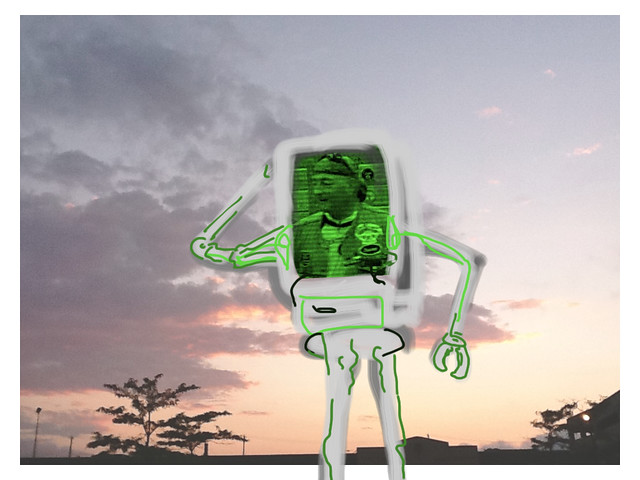
Untitled #77

Sometime last spring, I was having a Facebook "conversation" about some political thing or other, and, as sometimes happens when friends of friends start putting their two cents in there into an online forum, it turned into a Facebook argument shortly thereafter. Well, not an argument, exactly, but a heated discussion, carried on fairly intelligently, considering it was limited to bursts of 140 characters or less. Such is the life of an American political junkie in China...

I don't even remember the topic that we were discussing, but one comment that I do remember was something along the lines of "What's the use sitting around and discussing what's wrong with the world, anyway?"

...and I started to think, "Wellll... if we all could agree with what's wrong, we could all start to fix it, couldn't we?"  You know, how a flock of birds hangs out in a clump of trees for days and days, some flying off, and then all flying back, and you can hear them chirping and bickering for miles around.  And then one day - pow! - their collective mind is made up, and off they fly.  Together.

So, if we go with the idea that all of this chatter about what is wrong with this or that or the other thing in the world at large is really just the noise of the global flock making up its mind, then the individual conversations start to take on a greater meaning, don't they?  What may seem like an isolated argument on someone's Facebook page may actually be an artifact of the human community struggling to come to terms with its most pressing problems, in the same way that the chirps and hops of individual birds at some point add up to an action taken by the flock as a whole.

Don't know if this Tipping Point argument (see Malcolm Gladwell, et. al.) is true or not, but it does become an interesting way of looking at global change, politics, and the world at large.  From this point of view, discussions of issues among friends on Facebook are not just so many tempests in so many teapots, but our species' way of building global consensus, hashing out our issues on a molecular level.

A bit grandiose, perhaps?  Maybe.  I have certainly become increasingly suspicious of any kind of "Save the Word" argument in the last couple of years.  After all, the world has gotten along just fine without us for the last 4 billion years or so, and it will do just fine for the next 4 billion, regardless of whether us humans are on it or not.  But as a species, I'd like to think that in spite of everything, we're still worth keeping around.  Or worth improving, to put it more accurately.

Maybe our mantra should be, not "Save the World!", but rather:
"Hey everyone, let's all keep bickering back and forth good-naturedly for a while until we all can agree on a couple of simple ideas that are slightly less idiotic that our previous ones!"  
Yeah, yeah, it doesn't scan quite as well, does it?  But it does become more catchy after you repeat it a couple of times.  Give it a try, and let me know what you think.  I'll be posting the best results onto Facebook.


Saturday, September 10, 2011

How we ended up with Reality TV...

One Fine Morning

An interesting quote from my airline reading...
"Thousands of years ago, the work that people did had been broken down into jobs that were the same every day, in organizations where people were interchangeable parts.  All of the story had been bled out of their lives.  That was how it had to be; it was how you got a productive economy.  But it would be easy to see a will at work behind this: not exactly an evil will, but a selfish will.  The people who made the system thus were jealous, not of money and not of power but of story.  If their employees came home at day's end with interesting stories to tell, it meant that something had gone wrong: a blackout, a strike, a spree killing.  The Powers That Be would not suffer others to be in stories of their own unless they were fake stories that had been made up to motivate them."
The book is Anathem, by Neal Stephenson.  It's a big long chunky piece of science fiction sprinkled with a little too much long-winded philosophy, but it does a good job of creating a totally believable universe that your head can live in for a while, and that makes you see the planet that we happen to be on in a new light.  It's had me thinking of monasteries within monasteries, thousand year clocks, divergent realities, the power of a shared narrative, and what really happens when cultures interact. 

Saturday, April 30, 2011

Glimpses from the China Cave

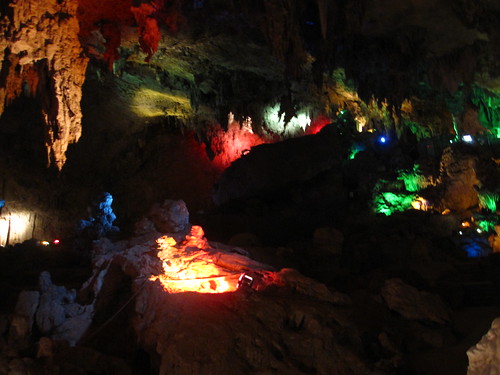
Swallow Cave, near Jianshui, Yunnan

One of the cool bits about China sometimes is that I can choose to live under the proverbial rock if I want to, as far as overhyped Western media events are concerned. For example, wasn't there some sort of wedding going on in England recently? I've posted about the tempest in a teacup effect before - how living in another country makes all of these so-called "major news stories" seem like so much nightclub smoke, and so many disco lasers bouncing off so many mirrors.

Another advantage is that, even if you haven't been swept away by the hype in the first place, you do get to sometimes read some pretty enlightening comments as the thing is winding down. An example from Scott Adams, writing about a recent bruhaha over a ... birth certificate? (Have I got that right? And is Donald Trump seriously a political contender?) Anyway, his point, albeit sarcastic, is that such media nonevents are actually good for our democracy. Read the article as well, but here are some good quotes to get you started...
It's healthy that we average citizens have some sort of topic in the political realm that will keep us engaged while also siphoning off some of our activist energy. It reminds us that we have a role in government. It reminds us that we have a constitution. It reminds us that we're in charge, sort of. And it gives the news media something to talk about on slow news days, which is important for keeping that vital institution in business.
And furthermore...
The birther issue is sort of like letting your toddler have a toy steering wheel in his car seat. He feels as if he's doing something useful and you don't have to rely on him to keep you out of the ravine.

Tuesday, April 5, 2011

American stories, from StoryCorps

The Icing on the Cake from StoryCorps on Vimeo.


Worth checking out if you haven't already - StoryCorps, from National Public Radio in the US. If you don't know about them, they have been traveling around the country gathering stories from anyone that wants to record them for the last ten years or so. Their web site has lots of really great interviews of ordinary people talking about important moments in their lives.

The story above, about, among other things, a mom making a sacrifice so that her daughter could get an education, really resonates with my students, as many of them are in college only because their parents have migrated to the big cities in the east of China to find jobs to support their families. I'll probably be showing more of these, as they are a pretty good window into American culture, and what connects us as humans in general...

The stories we miss

Don't know if I've mentioned it, but this semester, I've been teaching the theme of telling stories, with the aim of getting a web site with my students' stories, and others, on it up and running. We're on our way to making... well, something anyway, and I'll put up a link to what we've got in the next month or two. In the meantime, you may start to see a few disjointed ramblings about stories in general...

Rambling number one, which is quite obvious, but bears repeating - We often have no clue whatsoever about the stories that surround us. Take this guy for example:

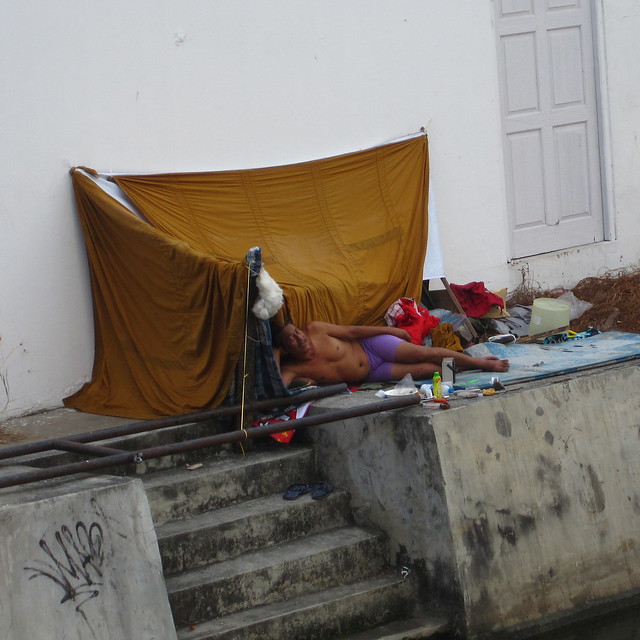
The view from canalside, Bangkok

We were crossing a bridge over one of the many canals and small rivers in Bangkok, and the first thing I saw when looking down was a huge monitor lizard sunning itself on a couple of pieces of bamboo floating in the water. The second thing that we saw was this guy on an embankment opposite, doing more or less the same thing. Homeless? A traveling monk? Or (more likely, now that I look) just a homeowner out catching the breeze on a cool stretch of river? There are clues in the picture, but I don't think I know enough about Bangkok or Thai culture in general to read them.

In the picture, he seems to have just noticed our family's presence on the bridge, and is smiling shyly at us, but that may simply be a coincidence of a camera shutter opening at one millisecond and not another. Maybe he nodded to us and we waved back to him? Or maybe he saw us staring, at got up to go? In reality, I have no memory of him noticing us at all. Just a hot hot afternoon, a guy in a purple sarong, and a big lizard on a raft of bamboo in a river.