This morning while getting ready for school, Ysa made a beeline for her fancy white short sleeve dress. Which would have been fine, except that we've had an unseasonable return of March in the last two days, and it's been cold, rainy, drizzly, and muddy. So no white dress.
"But Dad, I want to be like BaiXue GongZhu!"
"And who is BaiXue GongZu?"
"BaiXue GongZHU, Daddy!" (yes, my Chinese is still at the level where my four year old routinely corrects my pronunciation) "She's a princess!" The TV has been on a lot, because, um... we've been lazy parents?... >ahem< I mean, it's been helping our kids improve their Chinese tremendously. So princesses have been on her mind a great deal as of late.
As we continued getting ready, Ysa told me more about BaiXue GongZu (白雪公主), the White Snow Princess, who, as her name suggests, dresses only in white. And then something clicks - hey, she's talking about Snow White! Or at least a Chinese version thereof. Which got me thinking a little bit more about princesses, both Western and Chinese, and what both versions have in common - namely, hefty tie-ins to promotional marketing campaigns and a heavy reliance on princes.
So that was the inspiration to head off to YouTube, and follow through on my weeks-old promise to tell her all about Atalanta, the fastest and smartest princess around. The version below comes straight from my seventies childhood, via Free to Be, You and Me. (Thanks, Mom!) And it has Alan Alda doing the male voices - who knew?
After that, what more is there to say? When I picked her up from kindergarten, she told me that she wanted black hair and clothes like Atalanta's. I told her that it was a very old story, and that nobody knew exactly what color Atalanta's hair was really. And as far as clothes go, Atalanta wears whatever she wants, right? That seemed to satisfy her, so I allowed myself to savor a small moment of smug parental self-congratulation as I watched her run on ahead of me. As fast as she possibly could, with her hair streaming behind her.
Showing posts with label media. Show all posts
Showing posts with label media. Show all posts
Thursday, April 12, 2012


Tuesday, November 22, 2011

Saturday, November 12, 2011

Tuesday, November 8, 2011
Taken at the crossroads


A couple of pictures from the main intersection just outside the side gate of the university where we live.
Monday, October 3, 2011
Stuff we all should know by now - Prisoners in the US
What are approximately 1 out of every 100 Americans doing right now? Why, sitting in jail, of course! Young black men? That jumps to 1 in 10. Per capita, that's higher than most places in the world by an order of magnitude, and even higher that places with less-than-stellar human rights records such as Iran and, um, the country that I'm currently living in.
People in the US aren't terribly aware of this, but many other parts of the world are, as in, for example, this clip from a UK game show. Probably no wonder that other governments often don't take the US very seriously when it comes to accusations of human rights abuses...
For more information, and links to some of the facts in the video, click here.
Sunday, October 2, 2011
Anti-Intillectuatism in America, part 647.5
Yes, we're all populists now! I'd comment a bit more, but I think the title of the post says it all...
Harvard-Supported Harvard Grad Mitt Romney Criticizes Obama for being a Harvard-Supported Harvard Grad
Harvard-Supported Harvard Grad Mitt Romney Criticizes Obama for being a Harvard-Supported Harvard Grad
Saturday, October 1, 2011
Wow!!


Photos cropped from a kid's talent/variety show on CCTV (China Central Television), around a year ago or so.
Saturday, September 10, 2011
How we ended up with Reality TV...

An interesting quote from my airline reading...
"Thousands of years ago, the work that people did had been broken down into jobs that were the same every day, in organizations where people were interchangeable parts. All of the story had been bled out of their lives. That was how it had to be; it was how you got a productive economy. But it would be easy to see a will at work behind this: not exactly an evil will, but a selfish will. The people who made the system thus were jealous, not of money and not of power but of story. If their employees came home at day's end with interesting stories to tell, it meant that something had gone wrong: a blackout, a strike, a spree killing. The Powers That Be would not suffer others to be in stories of their own unless they were fake stories that had been made up to motivate them."The book is Anathem, by Neal Stephenson. It's a big long chunky piece of science fiction sprinkled with a little too much long-winded philosophy, but it does a good job of creating a totally believable universe that your head can live in for a while, and that makes you see the planet that we happen to be on in a new light. It's had me thinking of monasteries within monasteries, thousand year clocks, divergent realities, the power of a shared narrative, and what really happens when cultures interact.
Monday, June 27, 2011
Can I interest you in an eye care massager?

What I love about China: I can be sitting in my office in the English department, grading papers, and someone can walk in out of the blue and try to sell me a pair of opaque sunglasses with bumps on the back. Thankfully, my Chinese is good enough that I could A: understand the main gist of what she was asking me, and B: politely tell her that I was not interested.
Wednesday, May 11, 2011

Monday, May 9, 2011
It's a documentary! It's all really happening!
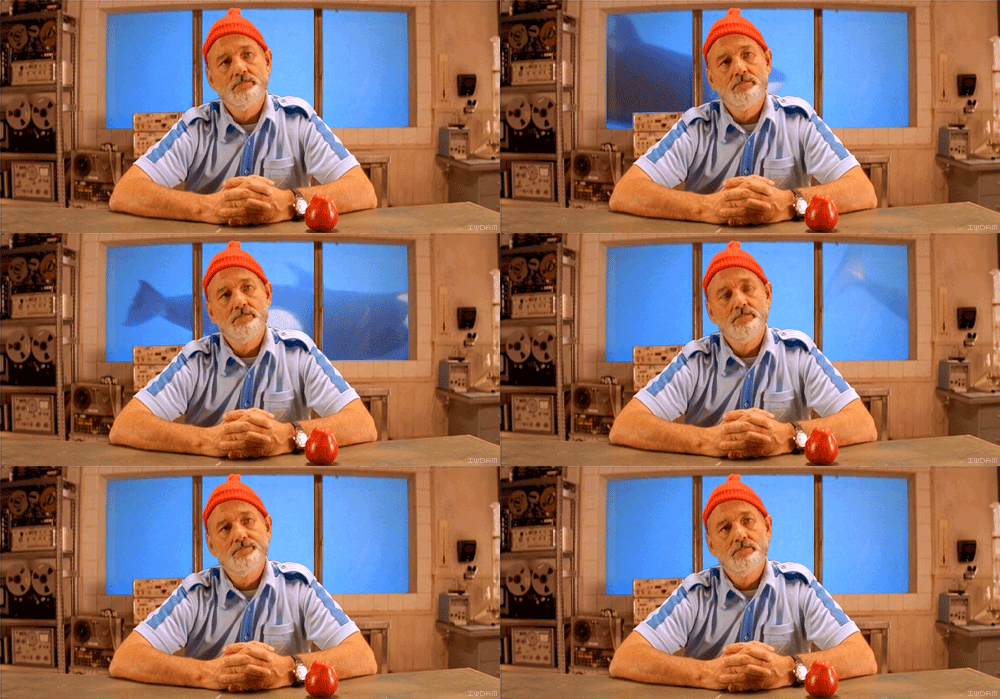
Helping us get the week off to an appropriately surreal start is this post from If we don't, remember me, a blog that features oddly subtle animations from all kinds of movies. Strangely addictive, and poetic to boot.
Wednesday, April 20, 2011
Sunday, December 5, 2010
"Zhi-jia-ge, zhi-jia-ge, that toddlin' town..."

Got a small dose of instant homesickness when I passed this construction fence in downtown Chengdu the other week. For those of you who aren't familiar with one of the greatest underrated cities on the planet, it's a view of downtown Chicago at night, probably taken from the observation lounge at the top of the John Hancock building, probably lifted from a Google image search somewhere and used without permission. (Said view, incidentally, being vastly superior to the one from the Sears Tower in that instead of paying $12 or so for a ticket up to the observation deck, you are obliged to purchase an overpriced martini at $7 and up, so you get a view and a drink.) Photos like these are quite typical around the new apartment towers that are springing up all over the place, probably because they convey a sense of wealth exoticism, and exclusivity. Pair them with a poorly-translated phrase in pseudoEnglish, and you're good to go. Ahh, the power of stereotypes...
Incidentally, 芝加哥 (Zhijiage), the word for "Chicago" in Chinese, translates character for character as “of - add to - older brother", or something like that. This happens because, of course, Chinese lacks a phonetic alphabet, so foreign names are simply collections of random characters thrown together to approximate the sound of the word in question. To make things even more confusing, Chinese has a little over 400 different spoken syllables, as opposed to somewhere around 4-5,000 in a language like English. This leads to most foreign place names in Chinese, for example, being only rough approximations of the original name. This makes for some exotic-sounding places (密尔沃基 - "Mi'erwaki", or 克利夫兰 - "Kelifulan") and another whole chunk of vocabulary to learn.
Thursday, December 2, 2010
Collaborative consumption
Okay, so this woman has a book to sell, but hey, maybe "buying less stuff, saving limited resources, sharing with people, and making the world a better place" could, in fact, use a more snazzy marketing label.
Ewww. I just used the word "snazzy"....
Ewww. I just used the word "snazzy"....
Friday, November 19, 2010
Ordinary Stuff - Subtitles Everywhere

One country + (multiple language families) x (countless dialects of each language) ÷ one set of characters used by nearly everyone = subtitles on nearly every television program so that people can understand what’s going on. Unless you don’t read Chinese very well. Sigh.
(Above, a music video in the Yi minority language with two sets of subtitles - Yi and simplified Mandarin)
Monday, November 8, 2010
Expo expose
I don't know how much coverage this year's Shanghai Expo got in the States (very little, I suspect), but here, it was all over the place, with another wave of big triumphant news stories in the Chinese media last week as the event shut down.
In that context, it was quite interesting to read this story, written by an American student who was a volunteer at the Expo's US pavilion this summer. For those of you (all of you?) who haven't been keeping up with the event, the US pavilion drew fire for being a bit of a let-down. I didn't see it myself, but it was seen as a fancy decorated shed, where the audience was invited to wait in line for an hour or two before watching three short movies.
The article paints an interesting picture of life behind the scenes at the event. A pavilion hijacked by corporate interests! Mistreatment of volunteers! Forced styrofoam catering! And, well, you'll have to read the rest yourself.
Is it just me, or is there a parable in the making here?
In that context, it was quite interesting to read this story, written by an American student who was a volunteer at the Expo's US pavilion this summer. For those of you (all of you?) who haven't been keeping up with the event, the US pavilion drew fire for being a bit of a let-down. I didn't see it myself, but it was seen as a fancy decorated shed, where the audience was invited to wait in line for an hour or two before watching three short movies.
The article paints an interesting picture of life behind the scenes at the event. A pavilion hijacked by corporate interests! Mistreatment of volunteers! Forced styrofoam catering! And, well, you'll have to read the rest yourself.
Is it just me, or is there a parable in the making here?
Friday, October 22, 2010
The Colony
Recently, I ran across this short documentary about Chinese immigrants living in the West African nation of Senegal.
All across Africa, Chinese entrepreneurs are setting up businesses, attracted by the availability of resources and the (relative to China) low level of competition. The film follows a few of these Chinese businessmen, and also gives equal weight to the Senegalese reaction to the Chinese newcomers.
The story is a typical immigrant story in that each side views the other group of people as extremely strange. The immigrant community, often distrustful of the local population, bands together and avoids interaction with the locals. The locals, meanwhile, starts to resent the immigrants because they are seen to be competing with the locals for jobs. It's made more complicated by the fact that China, with a growing population and finite resources, is looking to Africa as a source of raw materials for its expanding industry.
All in all, a very good film to show my students this week as we start talking about ethnocentrism, prejudice, and stereotypes. It was interesting to see my students' reaction to the film - lots of smiles of recognition as they saw the life that the Chinese immigrants had set up for themselves in Africa, and some gasps of astonishment when they heard the Africans' resentful remarks about the Chinese. (After all, these are kids who haven't been exposed to very much, if any, media criticism about their country or culture before.)
So, is China colonizing Africa? That was the question that I posed to my students after I made sure that they understood both sides' point of view: we'll see what answers they come up with next week.
All across Africa, Chinese entrepreneurs are setting up businesses, attracted by the availability of resources and the (relative to China) low level of competition. The film follows a few of these Chinese businessmen, and also gives equal weight to the Senegalese reaction to the Chinese newcomers.
The story is a typical immigrant story in that each side views the other group of people as extremely strange. The immigrant community, often distrustful of the local population, bands together and avoids interaction with the locals. The locals, meanwhile, starts to resent the immigrants because they are seen to be competing with the locals for jobs. It's made more complicated by the fact that China, with a growing population and finite resources, is looking to Africa as a source of raw materials for its expanding industry.
All in all, a very good film to show my students this week as we start talking about ethnocentrism, prejudice, and stereotypes. It was interesting to see my students' reaction to the film - lots of smiles of recognition as they saw the life that the Chinese immigrants had set up for themselves in Africa, and some gasps of astonishment when they heard the Africans' resentful remarks about the Chinese. (After all, these are kids who haven't been exposed to very much, if any, media criticism about their country or culture before.)
So, is China colonizing Africa? That was the question that I posed to my students after I made sure that they understood both sides' point of view: we'll see what answers they come up with next week.
Compare and Contrast
A few more real estate advertisements from close by, (this time in a more futuristic vein), along with a shot of the surrounding area.


Monday, October 18, 2010
Amusement and Control
Another wellspring of surrealism that I'll be exploring further during my extended surrealism appreciation week: the disparity between the "haves" and the "have nots" in a society.
Coming from a country that "Holds to be self-evident that all men are created equal," and having witnessed countless examples of the absence of this equality, I've always been interested in this problem. Who has power, and who doesn't? How do the people who have power keep it? How do people with little to no power respond to the situation? What tradeoffs do we make between power and security?
I'm writing this a week or two after the Nobel Prize was awarded to Liu Xiaobo, the imprisoned dissident who by now is probably the most famous Chinese citizen that most Chinese have never heard about. Much has already been written about the award and its repercussions, both within China and globally. What's surreal, of course, is being here in China and not feeling able to talk about it much. "Hey, everyone - did you see that big elephant walk by? It was on the news just now!" Oh, yeah, right, it's an invisible elephant. Sorry to bring it up...

I was reminded during all this of this cartoon by Stuart McMillan, talking about the differences between Orwell's 1984 and Huxley's Brave New World, two novels that, lest we become too smug, apply equally well to the dangers of power disparities in China or the United States. (Or anywhere else in the world where people use force and coercion to maintain power, come to think of it.) He's illustrating this quote from Neil Postman's Amusing Ourselves to Death:
Coming from a country that "Holds to be self-evident that all men are created equal," and having witnessed countless examples of the absence of this equality, I've always been interested in this problem. Who has power, and who doesn't? How do the people who have power keep it? How do people with little to no power respond to the situation? What tradeoffs do we make between power and security?
I'm writing this a week or two after the Nobel Prize was awarded to Liu Xiaobo, the imprisoned dissident who by now is probably the most famous Chinese citizen that most Chinese have never heard about. Much has already been written about the award and its repercussions, both within China and globally. What's surreal, of course, is being here in China and not feeling able to talk about it much. "Hey, everyone - did you see that big elephant walk by? It was on the news just now!" Oh, yeah, right, it's an invisible elephant. Sorry to bring it up...

I was reminded during all this of this cartoon by Stuart McMillan, talking about the differences between Orwell's 1984 and Huxley's Brave New World, two novels that, lest we become too smug, apply equally well to the dangers of power disparities in China or the United States. (Or anywhere else in the world where people use force and coercion to maintain power, come to think of it.) He's illustrating this quote from Neil Postman's Amusing Ourselves to Death:
"What Orwell feared were those who would ban books. What Huxley feared was that there would be no reason to ban a book, for there would be no one who wanted to read one. Orwell feared those who would deprive us of information. Huxley feared those who would give us so much that we would be reduced to passivity and egoism. Orwell feared that the truth would be concealed from us. Huxley feared the truth would be drowned in a sea of irrelevance. Orwell feared we would become a captive culture. Huxley feared we would become a trivial culture, preoccupied with some equivalent of the feelies, the orgy porgy, and the centrifugal bumblepuppy. As Huxley remarked in Brave New World Revisited, the civil libertarians and rationalists who are ever on the alert to oppose tyranny “failed to take into account man’s almost infinite appetite for distractions”. In 1984, Huxley added, people are controlled by inflicting pain. In Brave New World, they are controlled by inflicting pleasure. In short, Orwell feared that what we hate will ruin us. Huxley feared that what we love will ruin us."Check out the full version of "Orwell vs. Huxley" here.
Thursday, October 14, 2010

Subscribe to:
Posts (Atom)

