As we know, we humans are generally social creatures, deriving a large portion of our happiness from interaction with others of our kind. However, we are also by definition individuals, who obtain our identity from within. Thus is born the continuum between extrovert on one hand and introvert on the other. For some strange reason, we are, generally speaking, much more comfortable with the first end of this scale than the second.
Take this weekend, for example. A fine weekend indeed, and spent almost entirely at home with Zekey and Ysa. Highlights included finishing up a short video that I'd been working on, reading a bit, making black bean chili, editing some photographs, and chatting with Jane and a few friends in the States on Facebook and Skype. The kids played inside most of the day Saturday, half by themselves, and half with a (very loud) young friend who came over for a three hour long match of... Jedi knights? Ultraman? In any case, something involving a lot of swords and yelling, in (to me) nearly incomprehensible Chinese.
Sunday, more of the same in the morning, followed by an afternoon following the kids on their bikes as we went first to the exercise park (a small plaza fitted with generically dangerous clunky metal workout equipment that passes for our playground) and then to the paved lot in front of the elementary school, where I watched the kids interact with a streaming succession of friends, older schoolmates, friends' parents, giggling college girls trying to get them to pose for pictures on their cell phones, gaping grandparents who had never seen a foreigner before - still! after us being here for two years!! - trying to push their two year olds into playing with Ysa, who now knows how to deal with such behavior by a simple humph! and a turning away that is just charming enough not to be offensive...
Aaanyway, my point in all this is that, through all this, I don't think I had a face to face interaction with an adult that lasted more than ten minutes. And was fine about it. (Notice the obligatory disclaimer. You see what I mean about us humans feeling much less comfortable with the introverted end of the spectrum, right?)
All of this a long, round-about intro to this video, which, now that I've gone on for a while, really speaks for itself:
A good reminder that no matter where we travel, the most comfortable, and the most challenging place to live is inside your own skin.
Showing posts with label making connections. Show all posts
Showing posts with label making connections. Show all posts
Monday, October 24, 2011


Saturday, October 8, 2011
Stuff we should all know by now: Who's paying for your gas?
For this week's set-O-facts, a couple of different breakdowns of the subsidies that the US government gives the petroleum industry, compared with how much it helps solar and other forms of alternative energy.
First, this chart, showing the comparative amount spent on each sector:

And then this one, showing a couple of "what if" situations:

But solar isn't efficient yet! The subsidies are smaller because the solar industry is much smaller! Let's wait and give solar a chance to prove itself before we give them the money that they need to become more efficient. Ummm, anyone else sense a catch-22 here?
First, this chart, showing the comparative amount spent on each sector:

And then this one, showing a couple of "what if" situations:

But solar isn't efficient yet! The subsidies are smaller because the solar industry is much smaller! Let's wait and give solar a chance to prove itself before we give them the money that they need to become more efficient. Ummm, anyone else sense a catch-22 here?
Monday, September 26, 2011
Stuff we all should know by now - Doing the numbers
So then, class, let's get back to my posts about consensus, numbers, and Cookie Monster proclaiming the end of the world, shall we...?
To review a bit:
Let's take, as an example, the huge income disparity that now exists in America between its wealthiest citizens and everyone else. This can be represented in any number of ways, but let's simply take one statistic: today, the top 1% of Americans earn almost 25% of the income every year. Okay, big deal, big deal - what we need is more context, so let's compare it historically. Twenty five years ago, the figure was about half as much, at 12%. Turns out the last time this particular number was this high was in 1929.
Now, this is America, right? (Or, more globally speaking the internet. Readers from other countries, please bear with me for a bit...) You're free to think this is a good thing, or a bad thing. You can argue about the causes of the inequality, or its possible results. You can rephrase it, as in "Hey, the richest top ten percent pay 60% of the taxes." (Well, yeah, that's still saying the same thing, but less directly.) And, if all else fails, you can start to yell "Class Warfare" whenever someone who may vote you out of office brings it up.
What you can't do, however, is pretend otherwise, which is what it seems that many of us are doing. Here is a video of people taking a look at another statistic - the distribution of wealth in America.
For those of you with slow internet connections (or those with aversions to Warren Buffet for whatever reason), skip ahead to around 1:15. To sum up: here is the chart that most Americans surveyed selected when asked to chose one that shows what wealth distribution in America looks like (yellow representing the share of wealth held by the top 20%):

Nope! Sorry, that's Sweden. Here's a chart that shows the actual distribution of wealth in the US:

Good thing? Bad thing? I've got my opinions on the subject, and I hope that you've got yours. What we can't do, however, is pretend like it's otherwise, or tell ourselves that it really doesn't matter. Unless you live in Sweden*.
*in which case, you may want to feel smug for a moment or two, and then start looking at statistics for wealth distribution globally...
To review a bit:
A: We humans in general, and we Americans in particular, have a few problems that we need to figure out.To which I now will add...
B: An important step in solving these problems is coming to a consensus on what, exactly, these problems are.
C: It would be very helpful if everyone started with the same facts, then, wouldn't it?Or, put in to question format: What can be proven? What do the facts suggest, versus what is merely commonly held opinion? Put scientifically, then, what is actually observable in the world around us?
Let's take, as an example, the huge income disparity that now exists in America between its wealthiest citizens and everyone else. This can be represented in any number of ways, but let's simply take one statistic: today, the top 1% of Americans earn almost 25% of the income every year. Okay, big deal, big deal - what we need is more context, so let's compare it historically. Twenty five years ago, the figure was about half as much, at 12%. Turns out the last time this particular number was this high was in 1929.
Now, this is America, right? (Or, more globally speaking the internet. Readers from other countries, please bear with me for a bit...) You're free to think this is a good thing, or a bad thing. You can argue about the causes of the inequality, or its possible results. You can rephrase it, as in "Hey, the richest top ten percent pay 60% of the taxes." (Well, yeah, that's still saying the same thing, but less directly.) And, if all else fails, you can start to yell "Class Warfare" whenever someone who may vote you out of office brings it up.
What you can't do, however, is pretend otherwise, which is what it seems that many of us are doing. Here is a video of people taking a look at another statistic - the distribution of wealth in America.
For those of you with slow internet connections (or those with aversions to Warren Buffet for whatever reason), skip ahead to around 1:15. To sum up: here is the chart that most Americans surveyed selected when asked to chose one that shows what wealth distribution in America looks like (yellow representing the share of wealth held by the top 20%):
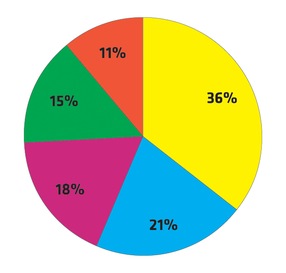
Nope! Sorry, that's Sweden. Here's a chart that shows the actual distribution of wealth in the US:

Good thing? Bad thing? I've got my opinions on the subject, and I hope that you've got yours. What we can't do, however, is pretend like it's otherwise, or tell ourselves that it really doesn't matter. Unless you live in Sweden*.
*in which case, you may want to feel smug for a moment or two, and then start looking at statistics for wealth distribution globally...
Sunday, September 25, 2011
A chart worth enlarging
This chart from the New York Times does a pretty good job of consolidating what's been on my mind lately. Yes, there may be a bit of editorializing about the captions chosen and the choice of time periods that have been contrasted, but the basic numbers are fairly plain to see. Are we paying attention?


Tuesday, September 20, 2011
Saving the World, one bicker at a time

Sometime last spring, I was having a Facebook "conversation" about some political thing or other, and, as sometimes happens when friends of friends start putting their two cents in there into an online forum, it turned into a Facebook argument shortly thereafter. Well, not an argument, exactly, but a heated discussion, carried on fairly intelligently, considering it was limited to bursts of 140 characters or less. Such is the life of an American political junkie in China...
I don't even remember the topic that we were discussing, but one comment that I do remember was something along the lines of "What's the use sitting around and discussing what's wrong with the world, anyway?"
...and I started to think, "Wellll... if we all could agree with what's wrong, we could all start to fix it, couldn't we?" You know, how a flock of birds hangs out in a clump of trees for days and days, some flying off, and then all flying back, and you can hear them chirping and bickering for miles around. And then one day - pow! - their collective mind is made up, and off they fly. Together.
So, if we go with the idea that all of this chatter about what is wrong with this or that or the other thing in the world at large is really just the noise of the global flock making up its mind, then the individual conversations start to take on a greater meaning, don't they? What may seem like an isolated argument on someone's Facebook page may actually be an artifact of the human community struggling to come to terms with its most pressing problems, in the same way that the chirps and hops of individual birds at some point add up to an action taken by the flock as a whole.
Don't know if this Tipping Point argument (see Malcolm Gladwell, et. al.) is true or not, but it does become an interesting way of looking at global change, politics, and the world at large. From this point of view, discussions of issues among friends on Facebook are not just so many tempests in so many teapots, but our species' way of building global consensus, hashing out our issues on a molecular level.
A bit grandiose, perhaps? Maybe. I have certainly become increasingly suspicious of any kind of "Save the Word" argument in the last couple of years. After all, the world has gotten along just fine without us for the last 4 billion years or so, and it will do just fine for the next 4 billion, regardless of whether us humans are on it or not. But as a species, I'd like to think that in spite of everything, we're still worth keeping around. Or worth improving, to put it more accurately.
Maybe our mantra should be, not "Save the World!", but rather:
"Hey everyone, let's all keep bickering back and forth good-naturedly for a while until we all can agree on a couple of simple ideas that are slightly less idiotic that our previous ones!"Yeah, yeah, it doesn't scan quite as well, does it? But it does become more catchy after you repeat it a couple of times. Give it a try, and let me know what you think. I'll be posting the best results onto Facebook.
Monday, September 19, 2011
I've got to stop watching documentaries right before going to bed...

I woke up this morning in the middle of a lucid dream where I was part of a documentary crew assigned to follow Jesus on a peacemaking tour among the gangs of South Central L.A. (Apparently, He's still a very good negotiator in such matters.) I was puled from the camera crew at the last minute because the main gang that we were following had just registered their name as a registered trademark, and the producers of the documentary were worried that the gang might sue us for copyright infringement if we accidentally caught Jesus mentioning the name of the gang on camera.
(No, I don't usually post my dreams to Anywhere, but this one seemed very apropos of, well, something, anyway. Not to be sacrilegious or anything, but isn't there a rule that states that when Jesus appears to you in a lucid dream, you have to share it on some form of social media? Think it's in the beginning of the Gospel of Matthew somewhere - I'll have to look it up to be sure...)
Saturday, September 17, 2011
Extreme Schooling?

Extreme Schooling, China Style
An interesting artice from the New York Times this weekend made me realize, "Oh yeah, we are doing something out of the ordinary, aren't we?" Titled Our Family's Experiment in Extreme Schooling, it's the story of a Clifford Levy, a Times reporter who's worked in Moscow for the last four years, and how his kids handled the culture shock of being dropped into a school where they (gasp!) only spoke Russian! From the article's introduction:
My three children once were among the coddled offspring of Park Slope, Brooklyn. But when I became a foreign correspondent for The New York Times, my wife and I decided that we wanted to immerse them in life abroad. No international schools where the instruction is in English. Ours would go to a local one, with real Russians.I've got to admit that one of my first reactions when reading this article (and watching the accompanying video, which you should make sure and see) was a half-suppressed disgusted snort and a sarcastic "Whoop-De-Doo!" Russian is a hard language? They've got an alphabet, for crying out loud! How hard can it be?? And a slight tinge of jealousy - man, I wish I could send my kids to a $10,000 a year private alternative school in Mandarin. And his kids get mistaken for Russians all the time! No way no how will our kids ever fit into China that seamlessly, that's for sure...
But some of the details from the article were also gut-wrenchingly familiar - the sinking feeling in your gut as a parent during that first year of immersion, knowing that you are sending your child into an environment where he understands next to nothing and is totally miserable. And the elation and beauty of hearing another language flow effortlessly out of your child's mouth at a school performance a year and a half later. And the familiar push and pull, now that we've been to the States and back, of "Where, exactly, does my child belong now?"
When all is said and done, entering another culture is an incredible leap to make, no matter how you do it. My congratulations to Clifford Levy and his wife, for deciding to guide their kids along the road less traveled instead of taking the easy way out. And more importantly, congratulations to Danya, Arden, and Emmet, his three kids, who are now citizens of the world, and seem to be much richer for it.
Friday, September 16, 2011
On Diversity, Labeling, Hospitality and Gratitude (Being a Short Treatise and Encapsulated Rant upon the nature of Difference among Peoples)
For your leisurely perusal: A list of the people and organizations who hosted Xander and I in America this summer, in chronological order. (In parentheses; religious affiliation, where applicable)
And of course, the labels also mean absolutely nothing. I'm sure that my friends who recognize themselves on the list are inwardly cringing right now. "What do you mean, I'm a traditional English folk dancer who can repair accordions and is now working in the IT department of a law firm? Is that all that I am to him??" Well of course not. A label, by its very nature, is a gross oversimplification of something far more complex. Labels are simply tools that we use to make sense of a world that is far more complicated than we can wrap our little minds around.
Diversity and labeling have been on my brain lately, as I'm back to being on campus in (fairly provincial) China. There's a new crop of freshman wandering around, which may explain why I'm hearing exclamations of “外国人, 外国人!" (Waiguoren, waigouren! = Foreigner! Foreigner!) all the time lately. And no, there is no revival of a certain seventies pop band over here - that's me they're talking about. Just this morning in fact, while crossing the little bridge on the way to Ysa's kindergarten, a clump of several girls walking by exclaimed "Waiguoren!" three times. In unison.
And you know, my reaction wasn't angry, or defensive, or hurt, like it sometimes is. But neither was I interested in being very sympathetic to them. It was more like feeling sadly embarrassed for somebody's total ignorance. Like when your dad would walk around in plaid shorts and sandals with socks. Black gold-toe socks. And sunburned knees to boot. But this was the opposite, generationally speaking, and I tried to throw in a little sip of optimism, because, hey, you never know, those kids may learn something about the rest of the world at some point in their lives, right...?
Not that it's my intention to start feeling smug about my culture's fine and noble sense of Diversity and Tolerance for Others. I mean, after all, I did grow up in labeling central, rural Illinois. And then there are articles like this one (seems like the FBI is schooling their agents to pigeonhole an entire religion. Good work, guys) that keep popping up all the time. And don't get me started on the current political climate (this is where we've chosen to focus our national discourse? Seriously??) in the Land That I Love.
But here I've spun off track a bit. It was originally about gratitude, and about how here, there, and everywhere, I've been incredibly blessed to find amazing people. Of all sorts and kinds, and I'm all the richer for it. This may sound like a canned soapbox speech from the Obama campaign (hey, everyone, remember when he was actually inspiring?), or a Coke commercial from the seventies, but no, it's been my life, for real. And any time I forget that fact, I find that I regret it sooner or later.
As for all that labeling that I was ranting about? Take a close look. Regardless of your political, social, religious or ethical affiliation(s). Are you doing it to anyone? No? Good. It's just embarrassing. Really. Stop it, already.
I mean it.
- A graphic designer and a writer, with one child; currently talking care of their mother with Alzheimer's. (agnostic / whatever?, culturally Jewish)
- A geography professor and a freelance blogger, with two kids (Jewish)
- A guest house for families of hospitalized children, run by a charity arm of a multinational corporation (Capitalist)
- A children's hospital run by the Ancient Arabic Order of the Nobles of the Mystic Shrine (The Shriners), a Masonic fraternal organization.
- A German / American couple - an archivist and an IT specialist, I think..? - currently living away from their home in Berlin and volunteering for the Mennonites, two kids. (Mennonite / Protestant)
- A (Catholic) doctor and an (Episcopal) priest, two kids.
- A healthcare management professional, currently laid off, and an administrator at a nonprofit agency, three kids (Catholic)
- A Polish-American soccer coach and beer distributor.
- A Vegan activist who recently adopted a poodle/terrier mix.
- Two lesbian Republicans with Libertarian Ayn Rand-inspired leanings, heading a bi-racial adoptive family.
- Predominantly white males in their late fifties and early sixties, who are mostly known for wearing red fezzes and driving miniature cars in parades.
- An expert in the history of milk in turn-of-the-century Chicago
- Two gay men in a committed long-term relationship. One from the Canary Islands with a passion for gardening, and one a former architecture student who was, at one point, making a pipe organ in his basement.
- A salesman of orthopedic hardware, recently relocated from Florida. Single, mid-fifties.
- A former East German draft dodger, who was once arrested while trying to escape on a train to Sweden.
- All of these people went out of their way to help us in some way
- All of them have a belief in something much bigger than themselves
- And most importantly, all of them have taken that belief as inspiration to do something to make their small part of the world a little bit better.
And of course, the labels also mean absolutely nothing. I'm sure that my friends who recognize themselves on the list are inwardly cringing right now. "What do you mean, I'm a traditional English folk dancer who can repair accordions and is now working in the IT department of a law firm? Is that all that I am to him??" Well of course not. A label, by its very nature, is a gross oversimplification of something far more complex. Labels are simply tools that we use to make sense of a world that is far more complicated than we can wrap our little minds around.
Diversity and labeling have been on my brain lately, as I'm back to being on campus in (fairly provincial) China. There's a new crop of freshman wandering around, which may explain why I'm hearing exclamations of “外国人, 外国人!" (Waiguoren, waigouren! = Foreigner! Foreigner!) all the time lately. And no, there is no revival of a certain seventies pop band over here - that's me they're talking about. Just this morning in fact, while crossing the little bridge on the way to Ysa's kindergarten, a clump of several girls walking by exclaimed "Waiguoren!" three times. In unison.
And you know, my reaction wasn't angry, or defensive, or hurt, like it sometimes is. But neither was I interested in being very sympathetic to them. It was more like feeling sadly embarrassed for somebody's total ignorance. Like when your dad would walk around in plaid shorts and sandals with socks. Black gold-toe socks. And sunburned knees to boot. But this was the opposite, generationally speaking, and I tried to throw in a little sip of optimism, because, hey, you never know, those kids may learn something about the rest of the world at some point in their lives, right...?
Not that it's my intention to start feeling smug about my culture's fine and noble sense of Diversity and Tolerance for Others. I mean, after all, I did grow up in labeling central, rural Illinois. And then there are articles like this one (seems like the FBI is schooling their agents to pigeonhole an entire religion. Good work, guys) that keep popping up all the time. And don't get me started on the current political climate (this is where we've chosen to focus our national discourse? Seriously??) in the Land That I Love.
But here I've spun off track a bit. It was originally about gratitude, and about how here, there, and everywhere, I've been incredibly blessed to find amazing people. Of all sorts and kinds, and I'm all the richer for it. This may sound like a canned soapbox speech from the Obama campaign (hey, everyone, remember when he was actually inspiring?), or a Coke commercial from the seventies, but no, it's been my life, for real. And any time I forget that fact, I find that I regret it sooner or later.
As for all that labeling that I was ranting about? Take a close look. Regardless of your political, social, religious or ethical affiliation(s). Are you doing it to anyone? No? Good. It's just embarrassing. Really. Stop it, already.
I mean it.
Saturday, September 10, 2011
How we ended up with Reality TV...

An interesting quote from my airline reading...
"Thousands of years ago, the work that people did had been broken down into jobs that were the same every day, in organizations where people were interchangeable parts. All of the story had been bled out of their lives. That was how it had to be; it was how you got a productive economy. But it would be easy to see a will at work behind this: not exactly an evil will, but a selfish will. The people who made the system thus were jealous, not of money and not of power but of story. If their employees came home at day's end with interesting stories to tell, it meant that something had gone wrong: a blackout, a strike, a spree killing. The Powers That Be would not suffer others to be in stories of their own unless they were fake stories that had been made up to motivate them."The book is Anathem, by Neal Stephenson. It's a big long chunky piece of science fiction sprinkled with a little too much long-winded philosophy, but it does a good job of creating a totally believable universe that your head can live in for a while, and that makes you see the planet that we happen to be on in a new light. It's had me thinking of monasteries within monasteries, thousand year clocks, divergent realities, the power of a shared narrative, and what really happens when cultures interact.
Once we start seeing each other, we just can't stop
Higher Ground | Playing For Change from Playing For Change on Vimeo.
One encouraging thing about the world as it stands is that it seems that many people around the world are making connections with each other that are more horizontal and global, if that makes any sense. Is shared interest taking precedence over narrow self interest after all? Are we starting to use the internet to create a global culture? I'd like to think so (he says with fingers crossed...)
And at least we're getting some really cool music out of the deal in the meantime. (Is it just me, or is this the Best Stevie Wonder Song Ever...?)
Thursday, August 11, 2011
Stuff we all should know by now: trains can work

Okay, and here I go trying to make sense of everything right off. One series of rants on the soapbox - errrr, make that posts - that I've been thinking about lately is "Stuff that we all should have figured out a long time ago but somehow still have a problem wrapping our brains around for reasons unknown."
Which I've conveniently shortened to "Stuff we all should know by now."
Rather than a long winded intro, which really is implicit in the title, let's lead on by example, shall we? Remember Carmageddon? Okay, neither do I - it was a media hype induced minor panic, from this summer, apparently because some two mile stretch of highway in L.A. was due to close in its entirety over a weekend. Or something.
Anyway, one post from the aforementioned media frenzy caught my eye - one of the guys over at Freakonomics doing a very simple "apples to apples" comparison of the number of people carried per hour by one lane of traffic versus the number of people a single commuter rail line, which takes up less space in a city, can carry.
The math is explained in a bit more detail in the article, but it basically boils down to this: one lane of traffic, under optimal conditions, can carry up to 2000 people per hour. A well-operated train line? Up to 40,000 people per hour.
So which system do we go with in America? Why, the system that makes the least sense, of course. Why? Beats me. Something to do with paragraph number one of this post, I suppose... Stay tuned for more.
Wednesday, July 6, 2011
Art, Scribbles, and Cy Twombly
From my distracted grazing through the internet this morning comes the news that the artist Cy Twombly died today at age 83. As quoted in the Washington Post -

When I started out studying painting at the Art Institute of Chicago, I suppose I found myself agreeing with that statement, though I was a bit too intimidated by the world of High Modern Art to say so. However, over time, I found myself warming up to his work - not necessarily because I had now acquired properly academic Good Taste (though that may have been a part of it), but mostly because Cy seemed to be having so much fun doing what he was doing, and it became contagious.

And because he did it so well! If you've ever worked with oil paint on big canvasses, you'll know that it's not so easy to move around the surface like he did. Doing large gestures like that, you run the risk of having your line looking boring and meaningless on one end of the spectrum, or like a self-indulgent puddle of vomit on the other. Twombly never let his paintings run to either extreme. He slung paint around like Zorro, and his gestures and scribbles turned from heroic to comic and back again.
The thing about abstraction like Twombly's is that once you start to appreciate it, things start to reverse in your mind. Instead of scoffing and saying, "Humph, my kid can do that!", you start to say, "Wow, my kid can do that, too!"

A wall becomes more than a wall. You start to see traces of time, history, and the hands and energy that made it.

(Of course, in this case, it helps that this particular wall was hand plastered and exposed to the elements for quite a while, but you can see my point, right...?)
You start to see art everywhere, even if it doesn't have a recognizable form as such. We all like to look at fireworks and fountains, right? They're simply moving versions of the same principle at work.


I'm not saying that makes me particularly cultured or insightful, but it does mean that I'm often easily amused...

(Look! Some kid built a shelf in the middle of this one!)
And am I the only dad that has a secret urge to join in with his kids in the competition for the window seat on the plane? I hope not...

You mean all along, we've been flying over abstract artworks? Shucks, they told me it was mountains...

Happy noticing, everyone!
One of his leading proponents, Kirk Varnedoe, a former curator at New York’s Museum of Modern Art, wrote in a 1994 essay that “Twombly is the original ‘My kid could do this’ sculptor and painter.”
When I started out studying painting at the Art Institute of Chicago, I suppose I found myself agreeing with that statement, though I was a bit too intimidated by the world of High Modern Art to say so. However, over time, I found myself warming up to his work - not necessarily because I had now acquired properly academic Good Taste (though that may have been a part of it), but mostly because Cy seemed to be having so much fun doing what he was doing, and it became contagious.
And because he did it so well! If you've ever worked with oil paint on big canvasses, you'll know that it's not so easy to move around the surface like he did. Doing large gestures like that, you run the risk of having your line looking boring and meaningless on one end of the spectrum, or like a self-indulgent puddle of vomit on the other. Twombly never let his paintings run to either extreme. He slung paint around like Zorro, and his gestures and scribbles turned from heroic to comic and back again.
The thing about abstraction like Twombly's is that once you start to appreciate it, things start to reverse in your mind. Instead of scoffing and saying, "Humph, my kid can do that!", you start to say, "Wow, my kid can do that, too!"
A wall becomes more than a wall. You start to see traces of time, history, and the hands and energy that made it.
(Of course, in this case, it helps that this particular wall was hand plastered and exposed to the elements for quite a while, but you can see my point, right...?)
You start to see art everywhere, even if it doesn't have a recognizable form as such. We all like to look at fireworks and fountains, right? They're simply moving versions of the same principle at work.
I'm not saying that makes me particularly cultured or insightful, but it does mean that I'm often easily amused...
(Look! Some kid built a shelf in the middle of this one!)
And am I the only dad that has a secret urge to join in with his kids in the competition for the window seat on the plane? I hope not...
You mean all along, we've been flying over abstract artworks? Shucks, they told me it was mountains...
Happy noticing, everyone!
Sunday, July 3, 2011
the iPad, revisited with Brushes
One of the reasons that I was all keen on getting an iPad was to have the chance to use a program (oh, excuse me, an app) called Brushes, which I'd read about off and on in the past couple of years. In particular, I'd heard about artist David Hockney's work with the program, and while some of his drawings on the iPad seem a touch on the cheesy side to me, I was excited about the idea of having a fairly portable painting studio that I could leave and come back to without any cleanup to speak of.
And then, right as we got the iPad, the news came in of the explosion in the nearby factory that produced it. The world news cycle has, of course, moved on, and we've had other things going on with our lives as well, but I'm still intrigued with the story. So while it might not be the prettiest subject for a set of paintings, I decided to make the explosion, and the events and landscapes surrounding it, the subject for my first experiments with the program. Here are some of my first attempts, presented without comment for now...


And then, right as we got the iPad, the news came in of the explosion in the nearby factory that produced it. The world news cycle has, of course, moved on, and we've had other things going on with our lives as well, but I'm still intrigued with the story. So while it might not be the prettiest subject for a set of paintings, I decided to make the explosion, and the events and landscapes surrounding it, the subject for my first experiments with the program. Here are some of my first attempts, presented without comment for now...
Friday, July 1, 2011
Some drawings I've been doing

No particular titles so far, and none with any concrete meanings that I've figured out yet. Some of them do look more Chinese than others, though..


Oh gosh, I guess this next one is a slow boat, isn't it?

Wednesday, June 1, 2011
the iPad and us (part 5, A Field Guide to Change in China)
Continuing on with our outsider's tour of the area around the Foxconn Factory, it's very obvious that the region is turning from this...

...to this.

Along the way, there's a whole lot of this:

This photo bears closer examination. Take a look at that apartment building in the middle. It's got about 30 floors, which, times 4 - 6 apartments per floor, times four people per apartment, times about ten buildings in the complex, yields a very conservative estimate of living space for at least 6000 people. Go down the road a bit, and there's another new apartment complex the same size or larger. Then another, and another. Just along the 15 minute route that I biked from my house to the Foxconn factory, I'd guess that I saw around ten of these complexes under construction, which translates to living space for about 60,000 people, about the same population of the "big city" of Moline, Illinois, near where I grew up.


So who's moving in to these instant cities? Right now, not very many people - lots of these buildings remain half vacant after they're built. Some apartments are bought by investors wanting to cash in on the skrocketing housing market (sound familiar, American readers?) and some remain unsold. So far, this housing bubble as kept these apartments out of reach to the people who work in, say, the Foxconn factory down the road. Down the road a few years? (or even six months?) Far be it from me to predict - I'm just a humble observer in these parts. The big challenge for China is whether the people who use the farm shed in picture #1 will eventually be able to afford the brand new apartments in picture #2.


...to this.
Along the way, there's a whole lot of this:
This photo bears closer examination. Take a look at that apartment building in the middle. It's got about 30 floors, which, times 4 - 6 apartments per floor, times four people per apartment, times about ten buildings in the complex, yields a very conservative estimate of living space for at least 6000 people. Go down the road a bit, and there's another new apartment complex the same size or larger. Then another, and another. Just along the 15 minute route that I biked from my house to the Foxconn factory, I'd guess that I saw around ten of these complexes under construction, which translates to living space for about 60,000 people, about the same population of the "big city" of Moline, Illinois, near where I grew up.
So who's moving in to these instant cities? Right now, not very many people - lots of these buildings remain half vacant after they're built. Some apartments are bought by investors wanting to cash in on the skrocketing housing market (sound familiar, American readers?) and some remain unsold. So far, this housing bubble as kept these apartments out of reach to the people who work in, say, the Foxconn factory down the road. Down the road a few years? (or even six months?) Far be it from me to predict - I'm just a humble observer in these parts. The big challenge for China is whether the people who use the farm shed in picture #1 will eventually be able to afford the brand new apartments in picture #2.
the iPad and us (part 4 - the outside scoop)
As the recent explosion at the local Foxconn factory slowly marches its way into the territory that is Yesterday's News, I thought I'd show some pictures I took while biking around the plant on the Sunday after the accident. There's been a lot of coverage of the conditions inside the factory, which I can't really add to, but not so much on what's outside. Herewith, then, some local context...

The Foxconn plant from afar. Note the piles of rubble from construction (or more accurately, destruction of a previous building) in the foreground - a prominent feature in the local landscape.


Another distant view of the plant with the new high speed train in the foreground, and the employee entrance close up. From the outside, I couldn't see any obvious damage to the plant.


That Sunday, there were maybe 100-150 workers gathered around the factory entrance. I was getting some stares from security guards, so I just snapped a few pictures on the sly as I biked by, feeling a bit like a spy...

A construction site that's presumably a new section of the Foxconn factory being built.

Landscaping surrounding the plant, with the new high speed train in the background. Note the ubiquitous double colored hedges, which are all trimmed by workers with orange safety vests and hand shears.

A rice field that's been recently burned off, with what I think are some of Foxconn's worker dorms in the background.

The dorms again with - you guessed it - another pile of rubble, this one also serving as a local garbage dump from the look of it.
If all this strikes you as fairly mundane and boring, it's because - well, it is. The whole area from here to Chengdu, which used to be mostly villages and rice fields as recently as five years ago, looks more or less like this now. I'm guessing that the only thing makes the Foxconn plant significantly different from the hundreds of factories and warehouses that now surround it is that it makes parts for a high-profile American company, and thus gets in the news when something bad happens.
The Foxconn plant from afar. Note the piles of rubble from construction (or more accurately, destruction of a previous building) in the foreground - a prominent feature in the local landscape.
Another distant view of the plant with the new high speed train in the foreground, and the employee entrance close up. From the outside, I couldn't see any obvious damage to the plant.
That Sunday, there were maybe 100-150 workers gathered around the factory entrance. I was getting some stares from security guards, so I just snapped a few pictures on the sly as I biked by, feeling a bit like a spy...
A construction site that's presumably a new section of the Foxconn factory being built.
Landscaping surrounding the plant, with the new high speed train in the background. Note the ubiquitous double colored hedges, which are all trimmed by workers with orange safety vests and hand shears.
A rice field that's been recently burned off, with what I think are some of Foxconn's worker dorms in the background.
The dorms again with - you guessed it - another pile of rubble, this one also serving as a local garbage dump from the look of it.
If all this strikes you as fairly mundane and boring, it's because - well, it is. The whole area from here to Chengdu, which used to be mostly villages and rice fields as recently as five years ago, looks more or less like this now. I'm guessing that the only thing makes the Foxconn plant significantly different from the hundreds of factories and warehouses that now surround it is that it makes parts for a high-profile American company, and thus gets in the news when something bad happens.
Saturday, May 28, 2011
the iPad and us (part 3 - the Story of Stuff)
Okay, here's a little video interlude in this whole bit. Ironically, it was the video I had shown to my students on the Thursday before the iPad plant explosion on Friday.
Yeah, I know, it's a bit simplified and propagandistic (and hey, what isn't?), but her main points are fairly clear and succinct, and bear repeating:


Next up: Getting closer to home....
Yeah, I know, it's a bit simplified and propagandistic (and hey, what isn't?), but her main points are fairly clear and succinct, and bear repeating:
- Most electronic products are "designed for the dump", that is, they are made to become quickly obsolete, so that consumers will get rid of them and buy new products and a faster rate.
- The amount of time that we own our electronic devices is just a short blip in their life cycle; they start affecting the environment from the moment their raw materials are extracted, and they continue to harm the environment through the release of toxins long after we throw them away.
- There are many externalized costs in the manufacture of consumer goods - negative effects from these products on people and the environment that are not paid by either the consumer or the manufacturer.
- Around the world, consumers are starting to demand that manufacturers start programs for product takeback - that they bear the burden of safely recycling their products after disposal.


Next up: Getting closer to home....
Sunday, May 15, 2011
Ordinary Stuff - Mmmm, Cherries...

It's cherry (and mulberry and waxberry) season here in Sichuan...

Hmmm, where have I seen these before...?

Thanks, China, for providing a flashback to a game that I loved when I was... three? four? and haven't thought about since. Take that, Marcel Proust!
Subscribe to:
Posts (Atom)

