Showing posts with label infrastructure. Show all posts
Showing posts with label infrastructure. Show all posts
Saturday, October 22, 2011
Imaginary cities
A short video I just finished editing, about urbanization, China, too many toys, and seduction (of a sort...). Oh, and Frank Sinatra.


Saturday, October 8, 2011
Stuff we should all know by now: Who's paying for your gas?
For this week's set-O-facts, a couple of different breakdowns of the subsidies that the US government gives the petroleum industry, compared with how much it helps solar and other forms of alternative energy.
First, this chart, showing the comparative amount spent on each sector:

And then this one, showing a couple of "what if" situations:

But solar isn't efficient yet! The subsidies are smaller because the solar industry is much smaller! Let's wait and give solar a chance to prove itself before we give them the money that they need to become more efficient. Ummm, anyone else sense a catch-22 here?
First, this chart, showing the comparative amount spent on each sector:

And then this one, showing a couple of "what if" situations:

But solar isn't efficient yet! The subsidies are smaller because the solar industry is much smaller! Let's wait and give solar a chance to prove itself before we give them the money that they need to become more efficient. Ummm, anyone else sense a catch-22 here?
Wednesday, August 17, 2011
Fixed

Don't know if this proves that the Chinese are in no way capable of taking over the world, or in fact the total opposite, but here, for what it's worth, is a repair job that I noticed in the mens' room in the new high speed section of the Nanchong train station.
Yes, the only thing connecting the bottom of that urinal to the floor drain is a green plastic iced tea bottle. And yes, in fact, every single urinal in the bathroom used a different kind of soda bottle for the exact same repair in the very same position. And no, I did not stand around documenting them all photographically - I got enough strange looks by being a foreigner with a camera in the mens' room as it was....
Thursday, August 11, 2011
Stuff we all should know by now: trains can work

Okay, and here I go trying to make sense of everything right off. One series of rants on the soapbox - errrr, make that posts - that I've been thinking about lately is "Stuff that we all should have figured out a long time ago but somehow still have a problem wrapping our brains around for reasons unknown."
Which I've conveniently shortened to "Stuff we all should know by now."
Rather than a long winded intro, which really is implicit in the title, let's lead on by example, shall we? Remember Carmageddon? Okay, neither do I - it was a media hype induced minor panic, from this summer, apparently because some two mile stretch of highway in L.A. was due to close in its entirety over a weekend. Or something.
Anyway, one post from the aforementioned media frenzy caught my eye - one of the guys over at Freakonomics doing a very simple "apples to apples" comparison of the number of people carried per hour by one lane of traffic versus the number of people a single commuter rail line, which takes up less space in a city, can carry.
The math is explained in a bit more detail in the article, but it basically boils down to this: one lane of traffic, under optimal conditions, can carry up to 2000 people per hour. A well-operated train line? Up to 40,000 people per hour.
So which system do we go with in America? Why, the system that makes the least sense, of course. Why? Beats me. Something to do with paragraph number one of this post, I suppose... Stay tuned for more.
Sunday, July 17, 2011
Training

One of the frustrations of blogging, and journaling in general, come to think of it, is the near impossibility of describing everything you want to describe. I've written about this before - how, if you start to retell an event, often, the retelling can seem like it takes more time than the event itself. Hence my respect for good biographers, travel writers, and anybody who can figure out ways to make nonfiction interesting in general...
This also explains why I post a lot about short day trips and one time events - it's not that we don't do anything else, it's just that these little bits are much easier to describe in the time from when I get up at six to when the kids are up and about demanding breakfast at 6:45. So there are always bits that I really want to write about, but stay in the back of my mind because I can't quite get a handle on how to start writing about them.
One such bit is a small steam train located in Jiayang, about a five hour trip on successive buses to the south and east of Chengdu. As the sign promises, it is the world's only out-of-print small steam train still in operation.

The train takes you up an isolated valley to the small mining town of Bagou. It's really an exercise in time travel, as most of the town hasn't changed much since the sixties. The train gets a few tourists, but the town, like most small villages in the Chinese countryside, has lost a great deal of its residents to jobs in the cities. What remains is a bit of a ghost town, and an interesting window into a Mao-era industrial collective.

The view from our guest house.

Another shot of the engine that got us there.

We went with our friends Lei King, a former student, and Jim, who was visiting the campus with a group of students from New York. Here they are at breakfast with a slightly blurry Xander.

The town square and the Chairman Mao Memorial Pavilion. More photos coming in the next post or three.
Monday, July 11, 2011
Two Years Ago - construction timelapse

Many of these pictures came from a hike around campus that Zekey and I took about three days after we had officially moved in, in late August sometime. If I stood at the exact same spot as I did when taking the above picture, you'd get a photo of a six foot tall concrete wall, so I had to back up a bit for this one.

For more pictures of this area, see this post from last September.
Yep, that's gotta be safe...

I'm sure of it. Safer at propping up high-voltage electrical cable than the 15-foot bamboo ladder sticking out of an oil drum that I saw along the same stretch of highway last winter, anyway. Y'see, this contraption has safety stripes...
Friday, July 8, 2011
Ordinary Stuff - Crowd control

A photo of the entrance to the North Train Station, Chengdu, on a fairly slow day. Since this is where the new (relatively new - it's been around for over a year now) high speed train drops us off when we go to Chengdu. What's impressive is that they get everyone through the security check fairly rapidly - the longest I've waited to get through is maybe 5 - 10 minutes.
Thursday, July 7, 2011
From the air

Walmart and Other "Big Box" Stores, Augusta, ME II, oil on canvas, 2006
Picking up a loose end from yesterday's post, I would be remiss if I didn't mention New York artist Yvonne Jacquette before moving on any further. Yeah, it's a bit of a tangent (welcome to my brain, ladies and gentlemen), but she's an interesting painter worth knowing about.
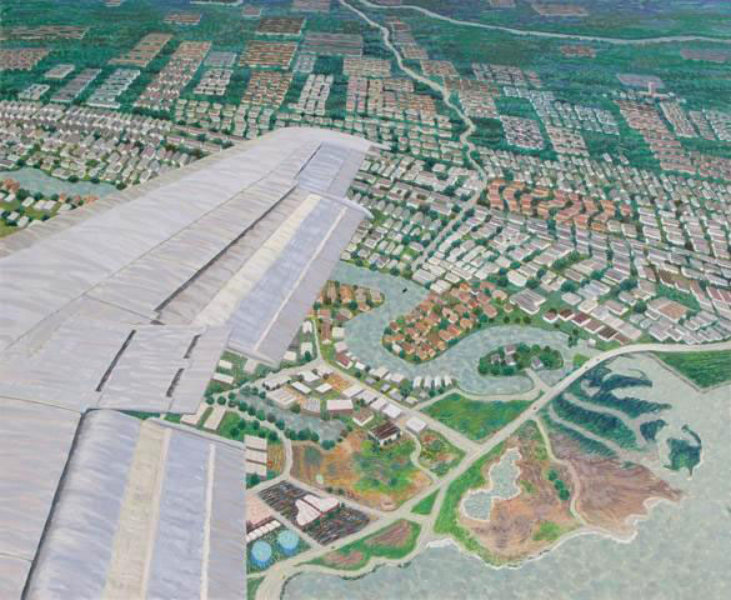
Right Wing II, oil on canvas, 1989
Her work captures the "Oh-my-gosh-I've-gotta-see-this!" feeling that you get (well, I still get, anyway) when looking down from far above.

Lake Shore Drive II, 1997-98
If you want to know more about her, this profile is a good place to start.
Sunday, June 26, 2011
The Old and the New, part Umpteen Million Six Hundred and Seven

Road construction, as seen in downtown Chengdu. Because you know, it's been, like, what, a whole month? since I've posted any construction pictures...
Wednesday, June 1, 2011
the iPad and us (part 5, A Field Guide to Change in China)
Continuing on with our outsider's tour of the area around the Foxconn Factory, it's very obvious that the region is turning from this...

...to this.

Along the way, there's a whole lot of this:

This photo bears closer examination. Take a look at that apartment building in the middle. It's got about 30 floors, which, times 4 - 6 apartments per floor, times four people per apartment, times about ten buildings in the complex, yields a very conservative estimate of living space for at least 6000 people. Go down the road a bit, and there's another new apartment complex the same size or larger. Then another, and another. Just along the 15 minute route that I biked from my house to the Foxconn factory, I'd guess that I saw around ten of these complexes under construction, which translates to living space for about 60,000 people, about the same population of the "big city" of Moline, Illinois, near where I grew up.


So who's moving in to these instant cities? Right now, not very many people - lots of these buildings remain half vacant after they're built. Some apartments are bought by investors wanting to cash in on the skrocketing housing market (sound familiar, American readers?) and some remain unsold. So far, this housing bubble as kept these apartments out of reach to the people who work in, say, the Foxconn factory down the road. Down the road a few years? (or even six months?) Far be it from me to predict - I'm just a humble observer in these parts. The big challenge for China is whether the people who use the farm shed in picture #1 will eventually be able to afford the brand new apartments in picture #2.


...to this.
Along the way, there's a whole lot of this:
This photo bears closer examination. Take a look at that apartment building in the middle. It's got about 30 floors, which, times 4 - 6 apartments per floor, times four people per apartment, times about ten buildings in the complex, yields a very conservative estimate of living space for at least 6000 people. Go down the road a bit, and there's another new apartment complex the same size or larger. Then another, and another. Just along the 15 minute route that I biked from my house to the Foxconn factory, I'd guess that I saw around ten of these complexes under construction, which translates to living space for about 60,000 people, about the same population of the "big city" of Moline, Illinois, near where I grew up.
So who's moving in to these instant cities? Right now, not very many people - lots of these buildings remain half vacant after they're built. Some apartments are bought by investors wanting to cash in on the skrocketing housing market (sound familiar, American readers?) and some remain unsold. So far, this housing bubble as kept these apartments out of reach to the people who work in, say, the Foxconn factory down the road. Down the road a few years? (or even six months?) Far be it from me to predict - I'm just a humble observer in these parts. The big challenge for China is whether the people who use the farm shed in picture #1 will eventually be able to afford the brand new apartments in picture #2.
Saturday, May 28, 2011
the iPad and us (part 3 - the Story of Stuff)
Okay, here's a little video interlude in this whole bit. Ironically, it was the video I had shown to my students on the Thursday before the iPad plant explosion on Friday.
Yeah, I know, it's a bit simplified and propagandistic (and hey, what isn't?), but her main points are fairly clear and succinct, and bear repeating:


Next up: Getting closer to home....
Yeah, I know, it's a bit simplified and propagandistic (and hey, what isn't?), but her main points are fairly clear and succinct, and bear repeating:
- Most electronic products are "designed for the dump", that is, they are made to become quickly obsolete, so that consumers will get rid of them and buy new products and a faster rate.
- The amount of time that we own our electronic devices is just a short blip in their life cycle; they start affecting the environment from the moment their raw materials are extracted, and they continue to harm the environment through the release of toxins long after we throw them away.
- There are many externalized costs in the manufacture of consumer goods - negative effects from these products on people and the environment that are not paid by either the consumer or the manufacturer.
- Around the world, consumers are starting to demand that manufacturers start programs for product takeback - that they bear the burden of safely recycling their products after disposal.


Next up: Getting closer to home....
Sunday, May 15, 2011
Ordinary Stuff - The Old and the New

A typical example of change in China - some remaining old style six story concrete apartment blocks with a new style thirty story apartment rising behind.
Tuesday, May 10, 2011
Home is a Fire
Via Boing Boing, a video made by graffiti artist Sheperd Fairey (who you should know about, already) for Death Cab for Cutie (okay, I'm probably supposed to know about them, but don't).
Ties in almost perfectly with Jane's ESL classes that she's teaching - theme: subcultures - except that I found this about ten minutes after she went to teach the class where her students are presenting on graffiti art. Oh well, such is timing sometimes...
Also like the video because (surprise surprise) it presents a city (LA, in this case) in the way that I tend to see it. Time to get out the video camera...
And a p.s. - also saw the graffiti art documentary Exit Through the Gift Shop a couple of weeks ago, which features Shepherd Fairy, Banksy, and other graffiti artists of the 90s and 2000s. Highly recommended!
Wednesday, May 4, 2011
A room with a view

Another thing that I've seen for the first time in China, again from our trip to Zigong: A hotel bathroom with a glass wall facing the room. You can (and we did) lower the blind for privacy, but its translucence meant that it made leaving the bathroom light on for the kids problematic. As the old saying goes, "People who live in glass houses should dress in the basement."
Saturday, April 16, 2011
Building elsewhere

A link that I meant to post a while ago when I was on a construction in China kick: photos from Bas Princen of new construction in the Middle East. If you've been in China, it all looks quite familiar... (only the climate has been changed to protect the innocent)
Saturday, March 26, 2011
How much food will a dollar buy?


Ten organic blueberries, apparently. Or a McDonald's cheeseburger. From a project by Jonathan Blaustein, who has simply photographed a dollar's worth of different foods available near his home in New Mexico. Would be very interesting to see what this project would look like here in China, as well. Maybe I'll put it on my to-do list? Oh, wait a minute - I see a homework assignment coming up....!
http://www.ecoliteracy.org/blog/how-much-food-will-dollar-buy
Thursday, December 16, 2010
Getting the construction bug

Over the last year or so that I've been blogging from China, I think I've made several promises to myself not to publish any more pictures of construction sites. Guess what? The vow gets broken yet again. Why? Ummm, perhaps because our area seems like one big construction site...? The latest local project: a tunnel under the main highway through what used to be the main village square.
Now Jane's into the act as well. These are pictures from her walk to catch the bus to get to her Chinese classes in Chengdu three times a week. Go Jane!


Monday, November 29, 2010
A whole lotta pink

Another picture from the Lotus wholesale market in Chengdu. And yes, pink is a girly girl color over here in China as well.
Incidentally, did you know that in the late 1800s in the US, pink was used for boys and light powder blue was considered a girls' color? As a shade of red, pink had the meaning of energetic, healthy, and powerful - as in the phrase "in the pink" - and therefore masculine. Meanwhile, blue was considered to be a more docile, relaxed, and melancholic, with more feminine overtones.
The original meanings, if my memory serves, faded around the turn of the century, and our current system of pink for girls and blue for boys started to catch on in the twenties and thirties. Anyway, that's what I remember from an incredibly interesting article that I read once and am too lazy to look up at the moment... (Would somebody care to Google it for me and get back to me with the results?)
Monday, November 1, 2010
Ordinary Stuff - Propped - Up Trees

Lots of new construction in China means lots of new landscaping. And lots of new landscaping means lots of newly transplanted trees, which stay wrapped up in rope and propped up with poles for the first year or two at their new tree residences (sometimes with a tree IV bag strapped on to their trunks).
Subscribe to:
Posts (Atom)

