Showing posts with label painting. Show all posts
Saturday, November 5, 2011
I don't know much about art, but I know what I like...
...and what I don't. And what I don't like so much that it ends up coming all the way around to me liking it again. Anyway, rather than prejudicing you with any further opinions, here are some finds from a trip into town last Friday. I'll let you sort out which ones work for you on your own...


Labels:
color,
observation,
painting,
portraits,
randomly observed,
still life
Thursday, July 7, 2011
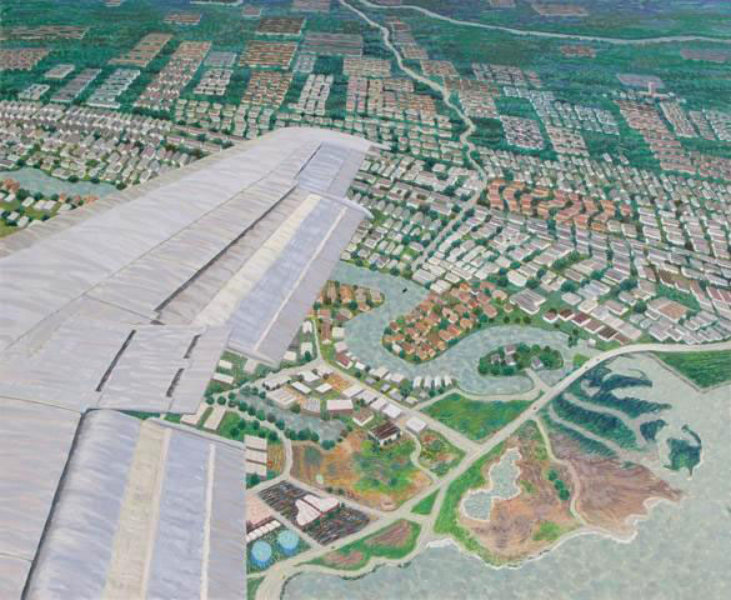
From the air
Walmart and Other "Big Box" Stores, Augusta, ME II, oil on canvas, 2006
Picking up a loose end from yesterday's post, I would be remiss if I didn't mention New York artist Yvonne Jacquette before moving on any further. Yeah, it's a bit of a tangent (welcome to my brain, ladies and gentlemen), but she's an interesting painter worth knowing about.
Right Wing II, oil on canvas, 1989
Her work captures the "Oh-my-gosh-I've-gotta-see-this!" feeling that you get (well, I still get, anyway) when looking down from far above.
Lake Shore Drive II, 1997-98
If you want to know more about her, this profile is a good place to start.
Wednesday, July 6, 2011
Art, Scribbles, and Cy Twombly
From my distracted grazing through the internet this morning comes the news that the artist Cy Twombly died today at age 83. As quoted in the Washington Post -

When I started out studying painting at the Art Institute of Chicago, I suppose I found myself agreeing with that statement, though I was a bit too intimidated by the world of High Modern Art to say so. However, over time, I found myself warming up to his work - not necessarily because I had now acquired properly academic Good Taste (though that may have been a part of it), but mostly because Cy seemed to be having so much fun doing what he was doing, and it became contagious.

And because he did it so well! If you've ever worked with oil paint on big canvasses, you'll know that it's not so easy to move around the surface like he did. Doing large gestures like that, you run the risk of having your line looking boring and meaningless on one end of the spectrum, or like a self-indulgent puddle of vomit on the other. Twombly never let his paintings run to either extreme. He slung paint around like Zorro, and his gestures and scribbles turned from heroic to comic and back again.
The thing about abstraction like Twombly's is that once you start to appreciate it, things start to reverse in your mind. Instead of scoffing and saying, "Humph, my kid can do that!", you start to say, "Wow, my kid can do that, too!"

A wall becomes more than a wall. You start to see traces of time, history, and the hands and energy that made it.

(Of course, in this case, it helps that this particular wall was hand plastered and exposed to the elements for quite a while, but you can see my point, right...?)
You start to see art everywhere, even if it doesn't have a recognizable form as such. We all like to look at fireworks and fountains, right? They're simply moving versions of the same principle at work.


I'm not saying that makes me particularly cultured or insightful, but it does mean that I'm often easily amused...

(Look! Some kid built a shelf in the middle of this one!)
And am I the only dad that has a secret urge to join in with his kids in the competition for the window seat on the plane? I hope not...

You mean all along, we've been flying over abstract artworks? Shucks, they told me it was mountains...

Happy noticing, everyone!
One of his leading proponents, Kirk Varnedoe, a former curator at New York’s Museum of Modern Art, wrote in a 1994 essay that “Twombly is the original ‘My kid could do this’ sculptor and painter.”
When I started out studying painting at the Art Institute of Chicago, I suppose I found myself agreeing with that statement, though I was a bit too intimidated by the world of High Modern Art to say so. However, over time, I found myself warming up to his work - not necessarily because I had now acquired properly academic Good Taste (though that may have been a part of it), but mostly because Cy seemed to be having so much fun doing what he was doing, and it became contagious.
And because he did it so well! If you've ever worked with oil paint on big canvasses, you'll know that it's not so easy to move around the surface like he did. Doing large gestures like that, you run the risk of having your line looking boring and meaningless on one end of the spectrum, or like a self-indulgent puddle of vomit on the other. Twombly never let his paintings run to either extreme. He slung paint around like Zorro, and his gestures and scribbles turned from heroic to comic and back again.
The thing about abstraction like Twombly's is that once you start to appreciate it, things start to reverse in your mind. Instead of scoffing and saying, "Humph, my kid can do that!", you start to say, "Wow, my kid can do that, too!"
A wall becomes more than a wall. You start to see traces of time, history, and the hands and energy that made it.
(Of course, in this case, it helps that this particular wall was hand plastered and exposed to the elements for quite a while, but you can see my point, right...?)
You start to see art everywhere, even if it doesn't have a recognizable form as such. We all like to look at fireworks and fountains, right? They're simply moving versions of the same principle at work.
I'm not saying that makes me particularly cultured or insightful, but it does mean that I'm often easily amused...
(Look! Some kid built a shelf in the middle of this one!)
And am I the only dad that has a secret urge to join in with his kids in the competition for the window seat on the plane? I hope not...
You mean all along, we've been flying over abstract artworks? Shucks, they told me it was mountains...
Happy noticing, everyone!
Labels:
abstraction,
landscape,
making connections,
observation,
painting,
photos,
texture
Sunday, July 3, 2011
Hockney on the iPhone
An interesting video from art critic Laurence Wechsler that I found on iFilmography about David Hockney's work using the iPhone, well worth watching:
Oh, and a cool article about him, if you want to go more in depth. Now, if you'll excuse me, I've got to get onto the computer and paint...
the iPad, revisited with Brushes
One of the reasons that I was all keen on getting an iPad was to have the chance to use a program (oh, excuse me, an app) called Brushes, which I'd read about off and on in the past couple of years. In particular, I'd heard about artist David Hockney's work with the program, and while some of his drawings on the iPad seem a touch on the cheesy side to me, I was excited about the idea of having a fairly portable painting studio that I could leave and come back to without any cleanup to speak of.
And then, right as we got the iPad, the news came in of the explosion in the nearby factory that produced it. The world news cycle has, of course, moved on, and we've had other things going on with our lives as well, but I'm still intrigued with the story. So while it might not be the prettiest subject for a set of paintings, I decided to make the explosion, and the events and landscapes surrounding it, the subject for my first experiments with the program. Here are some of my first attempts, presented without comment for now...


And then, right as we got the iPad, the news came in of the explosion in the nearby factory that produced it. The world news cycle has, of course, moved on, and we've had other things going on with our lives as well, but I'm still intrigued with the story. So while it might not be the prettiest subject for a set of paintings, I decided to make the explosion, and the events and landscapes surrounding it, the subject for my first experiments with the program. Here are some of my first attempts, presented without comment for now...
Sunday, May 15, 2011
Next up, Picasso's Orange Period...
Wednesday, November 24, 2010
Wayne and Jerry. And cakes.
Okay, all quiz for all you artsy types. Which painter am I reminded of every time I pass this store just outside of the side gate of our university?

Did you say Wayne Thiebaud? Yeah, I know, that one was too easy. At least if you've ever seen his paintings, that is.
If you’ve never heard of Thiebaud, or don't know much more about him other than his signature cake paintings, now’s your chance to click this link and get right on it. Go ahead, I’ll wait...
Okay, done? Nice paintings, right? A little bit candy coated, perhaps, but nice. You may have seen them hanging in the modern section of your local neighborhood art museum, right next to the big black square painting that your mom couldn’t figure out. If you went to A Serious Art School, one of your professors might have dismissed him as “one of those decorative California painters”, and you may have had a twinge of guilt for liking something that was, well, pretty.
Now on the other hand, Jerry Rudquist, my first painting professor in college, really liked Thiebaud’s paintings. I mean, really really liked them, as in “let’s put up a slide of one of his paintings in a dark room and talk about it in a monotone for forty-five minutes running” liked them.
Given that, students of his had two choices - either:
Wayne, the master of composition and sneaky bits of color. Wayne, the guy who can snake a horizon line right up to the corner of a painting and get away with it, still in California, still painting at age 90.
Jerry, who introduced me to Wayne, and Piet and Jan and Paul and many other painters that I’ve stared at so long that they’re past first name basis and now simply part of my mind. Jerry who introduced me to complimentary color and rhythmic composition. Jerry, who passed away in 2001, and was one of the first people to introduce me to the habit of looking deeply at things.
Did you say Wayne Thiebaud? Yeah, I know, that one was too easy. At least if you've ever seen his paintings, that is.
Wayne Thiebaud, Cakes, 1963
If you’ve never heard of Thiebaud, or don't know much more about him other than his signature cake paintings, now’s your chance to click this link and get right on it. Go ahead, I’ll wait...
Okay, done? Nice paintings, right? A little bit candy coated, perhaps, but nice. You may have seen them hanging in the modern section of your local neighborhood art museum, right next to the big black square painting that your mom couldn’t figure out. If you went to A Serious Art School, one of your professors might have dismissed him as “one of those decorative California painters”, and you may have had a twinge of guilt for liking something that was, well, pretty.
Now on the other hand, Jerry Rudquist, my first painting professor in college, really liked Thiebaud’s paintings. I mean, really really liked them, as in “let’s put up a slide of one of his paintings in a dark room and talk about it in a monotone for forty-five minutes running” liked them.
Given that, students of his had two choices - either:
- fall into a deep slumber dreaming of cake, or
- develop a taste for the nasty acid sludge from the coffee maker by the art department office, prop open your eyelids, learn how to look at a painting for a long long time, and discover things about paint, color, composition and space that you never ever knew before. Oh, and develop a deep and lasting appreciation for cakes, especially those that are artfully arranged.
Wayne, the master of composition and sneaky bits of color. Wayne, the guy who can snake a horizon line right up to the corner of a painting and get away with it, still in California, still painting at age 90.
Jerry, who introduced me to Wayne, and Piet and Jan and Paul and many other painters that I’ve stared at so long that they’re past first name basis and now simply part of my mind. Jerry who introduced me to complimentary color and rhythmic composition. Jerry, who passed away in 2001, and was one of the first people to introduce me to the habit of looking deeply at things.
Saturday, November 13, 2010
Remembering how to see
I was incredibly happy to notice the other day that James Elkins, one of my favorite professors from grad school, has started writing a blog for the Huffington Post. His first couple of posts are great, and have got me thinking again about looking, thinking, and paying attention to the world around you.
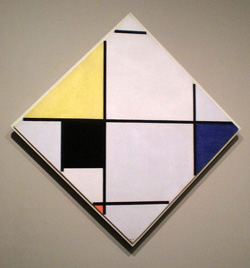
If you have ever, for example, walked by a Mondrian in an art museum and said, "Okay, what's the big deal with that one?"
...then this post should be required reading. And how long does it take to look at a painting, anyway?
An added bonus for me when reading his essays is that, because he's a professor at the School of Art Institute of Chicago, all of the paintings that he's describing are ones that I've also spent a great deal of time with. It's like finding a newspaper article that happens to mention several old friends of yours that you haven't seen in a year or two. Quite nice to catch up, though it does make me a bit homesick for a couple of rooms full of big, juicy, well-made paintings about now...
Subscribe to:
Posts (Atom)